What Changed
On March 17, 2026, the SEC and CFTC jointly published Interpretive Release No. 33-11412, a 68-page ruling that formally classifies digital assets into five categories. Four are outside securities law. Only one, Digital Securities, falls under the SEC's full remit. The enforcement-driven approach of previous administrations is replaced with a clear, rules-based framework.
The Five-Category Asset Classification
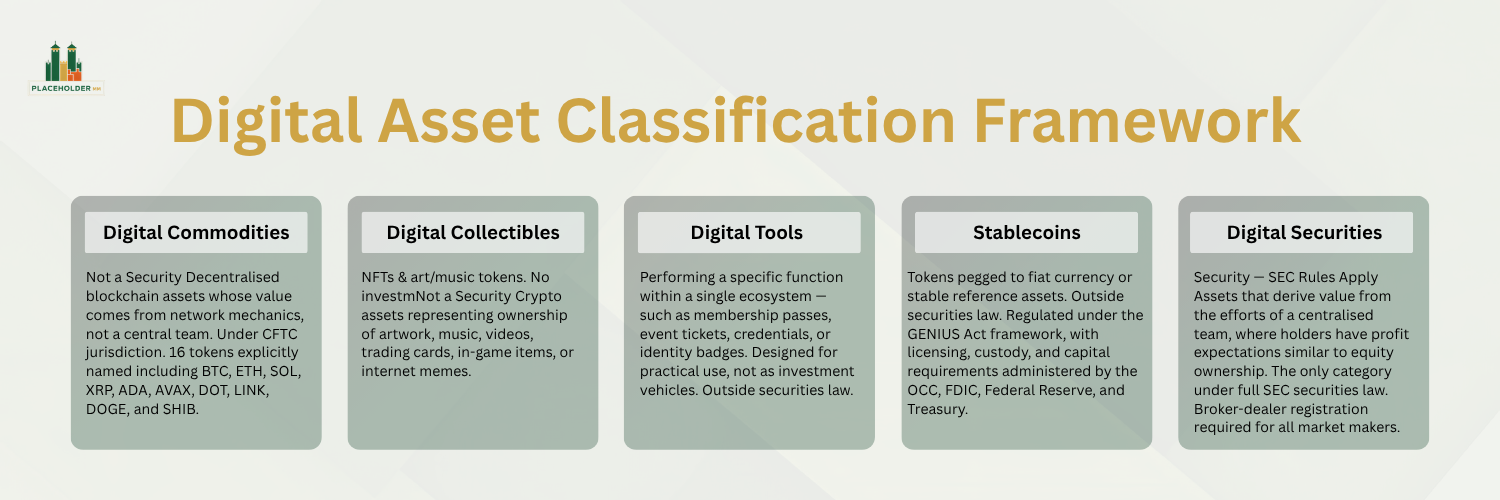
Four categories are outside securities law, only Digital Securities (Category 5) falls under the SEC.
Category 1 — Digital Commodities (Not a Security · CFTC)
Decentralised assets whose value comes from network mechanics, not a central team. Under CFTC jurisdiction. 16 tokens named: BTC, ETH, SOL, XRP, ADA, AVAX, DOT, LINK, XLM, HBAR, LTC, DOGE, SHIB, BCH, APT, XTZ.
Category 2 — Digital Collectibles (Not a Security)
NFTs and tokens representing rights to artwork, music, videos, trading cards, or in-game items. Outside securities law where no investment expectation exists.
Category 3 — Digital Tools (Not a Security)
Tokens serving a specific functional purpose — membership passes, tickets, credentials, or identity badges. Outside securities law.
Category 4 — Stablecoins (Not a Security · GENIUS Act)
Fiat-pegged tokens outside securities law. Governed by the GENIUS Act framework under the OCC, FDIC, Federal Reserve, and Treasury — implementing rules expected mid-2026.
Category 5 — Digital Securities (Security · SEC)
The only category under full SEC securities law. Assets where holders expect profit from a central team's efforts. Broker-dealer registration required for market makers. Legal counsel required before any US listing.
Source: SEC/CFTC Interpretive Release No. 33-11412, March 17, 2026 · sec.gov/files/rules/interp/2026/33-11412.pdf
What It Means in Practice
The table below summarises the regulatory regime and market making implication for each category. Formal market maker registration rules are still pending, expected under the CLARITY Act once the Senate acts.
| Category | Regulator | Key Examples | Market Making Implication |
|---|---|---|---|
| Digital Commodity | CFTC | BTC, ETH, SOL, XRP, ADA + 11 more | CFTC intermediary rules apply |
| Digital Collectible | Outside securities law | NFTs, art, music, in-game items | No securities registration required |
| Digital Tool | Outside securities law | Passes, tickets, credentials | No securities registration required |
| Stablecoin | OCC / Treasury | USD-backed stablecoins | GENIUS Act framework applies |
| Digital Security | SEC | Project-specific | Broker-dealer registration required |
What Happens Next
Release No. 33-11412 in effect. Five-category taxonomy applies immediately as interpretive guidance.
SEC innovation exemption. Regulatory sandbox for new crypto products under lighter requirements.
GENIUS Act rules finalised. Stablecoin licensing, custody, and capital requirements confirmed.
CLARITY Act, Senate pending. Would establish formal registration for digital commodity exchanges, brokers, and dealers under CFTC.
PlaceholderMM's Position
Our current focus markets, Binance, Upbit, and Korean exchanges, operate under separate regulatory frameworks and are not directly affected by this release. EU-focused projects should review the MiCA compliance requirements that are already fully enforced. For clients with US market ambitions, we are monitoring developments closely and can discuss how your token's likely classification affects your listing roadmap. See how the leading market makers are positioned in our 2026 ranking →
