What OnlyCEX Actually Is
OnlyCEX is a trading campaign platform that sits on top of centralised exchanges. It works like this: traders connect their existing exchange account via API, such as Binance or KuCoin, join a campaign, trade as they normally would, and get ranked on a leaderboard. Top performers earn rewards, usually paid in USDT.
The key design principle is non-custodial. Your funds never leave your exchange. OnlyCEX does not hold assets, manage positions, or execute trades on your behalf. It simply tracks your trading activity through an API connection and distributes rewards based on performance metrics: volume, profitability, or a combination, depending on the campaign structure.
From a token project's perspective, OnlyCEX campaigns create a short-term incentive for traders to actively trade your token. A well-designed campaign generates volume spikes, community participation, and leaderboard-driven engagement during key windows: token launches, exchange listing events, or marketing pushes.
What Traditional CEX Market Making Is
A professional market maker operates at a completely different layer. Where OnlyCEX incentivises traders to generate volume, a market maker manages the order book itself, posting and maintaining buy and sell orders continuously on both sides of the market, controlling spread, managing depth at multiple price levels, and absorbing inventory risk 24 hours a day, seven days a week.
The market maker's mandate is not to generate trading volume. It is to ensure that when any retail or institutional trader wants to buy or sell your token, there is always a counterparty available at a competitive price, with minimal slippage. That consistency is what exchanges evaluate when deciding whether to list a token, maintain its tier, or delist it.
For a full breakdown of how professional market making works on centralised exchanges, including deal structures, KPIs, and what to look for in a term sheet — see the CEX market making guide and the founder's guide to token loan deals.
The Core Difference: Incentives vs. Infrastructure
This is the distinction that matters most for token founders. OnlyCEX creates incentives for traders to generate volume. Market making creates the infrastructure that makes your token tradeable. These are two entirely separate problems.
A token with excellent OnlyCEX campaign volume but no professional market maker will have wide spreads, shallow order book depth, and high slippage. Institutional buyers avoid it. Exchange listing committees flag it. The volume number looks good; the liquidity health score does not.
A token with a professional market maker but no community engagement campaigns may have excellent order book health but low organic trading volume, which creates its own problems for exchange tier maintenance and community momentum.
Liquidity Infrastructure
Controls spread, depth, and uptime 24/7. Required for exchange listing and tier maintenance. Absorbs inventory risk. Institutional investors check these metrics before entering a position.
Volume & Community Incentives
Drives trading activity through leaderboard competitions and USDT rewards. Non-custodial. Effective for community engagement and volume spikes during key windows.
What Exchanges Actually Measure
When an exchange evaluates your token for listing or tier review, the metrics they pull are not raw trading volume. They look at spread consistency, specifically whether your bid-ask spread holds at a competitive level across normal trading hours. They look at order book depth, whether there is sufficient liquidity at multiple price levels to absorb reasonable-sized trades without significant slippage. And they look at uptime, whether the market is continuously maintained or disappears during volatile periods.
OnlyCEX campaigns can move the volume number. They cannot move spread, depth, or uptime. Those three metrics require a professional market maker with a dedicated inventory position and 24/7 execution infrastructure. For a deeper look at why volume is often the wrong metric to focus on, see The Problem With Using CEX Volume as a Proxy for Liquidity Health.
| Metric | OnlyCEX Campaigns | Professional Market Making |
|---|---|---|
| Trading Volume | High impact (campaign period) | Moderate, consistent baseline |
| Bid-Ask Spread | No direct control | Primary KPI, actively managed |
| Order Book Depth | No direct control | Primary KPI, actively managed |
| Uptime | Campaign-dependent | 24/7, contractual commitment |
| Custody of Funds | Non-custodial | Token loan (collateralised) |
| Exchange Listing Score | Indirect boost via volume | Direct impact on listing quality |
| Community Engagement | High, leaderboard competition | Not a primary function |
When OnlyCEX Makes Sense
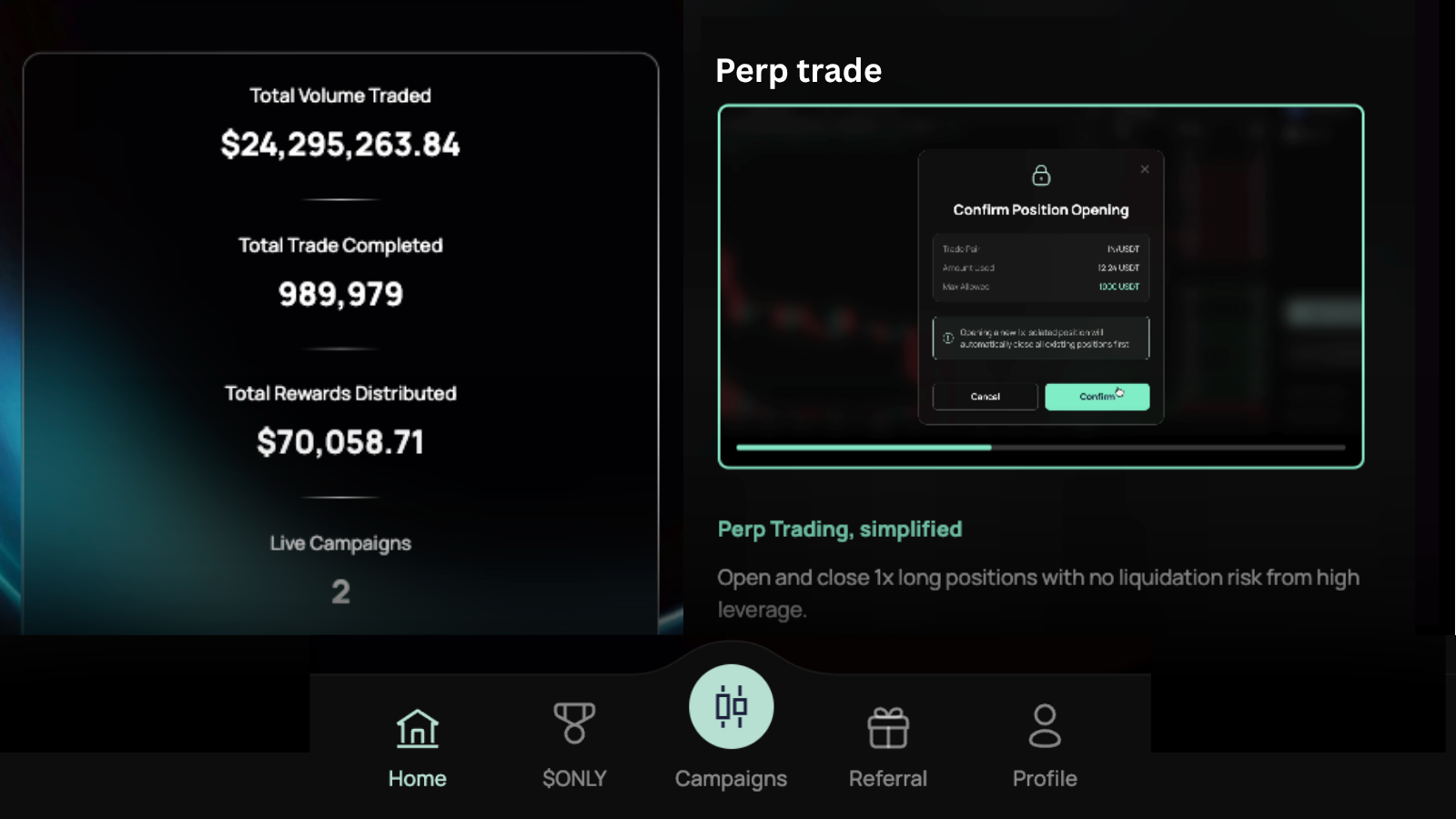
OnlyCEX campaigns are well-suited to specific moments in a token's lifecycle: immediately following a new exchange listing, when you want to activate community trading and generate visible volume in the first weeks of live trading. Around major announcements, such as protocol upgrades, partnership reveals, or governance votes, to convert attention into trading activity. During sustained community growth phases where gamified trading competitions deepen holder engagement and attract new participants to the ecosystem.
The non-custodial model is a genuine advantage. There is no additional trust requirement beyond API access, no asset transfer, and no additional counterparty risk. For community-facing campaigns, that lowers the barrier to participation significantly.
When You Need a Professional Market Maker
A professional market maker is not optional for any token serious about exchange listing quality, institutional access, or Korean exchange inclusion. Upbit and Bithumb listing committees require demonstrable order book health, specifically consistent spreads and depth over 90+ days, before they evaluate a listing application. No OnlyCEX campaign produces that data. Only a market maker does.
Before any major listing application, maintain a professional market maker on your existing exchange for at least 90 days. That order book history is the primary data source listing committees use. For the full pathway to Korean exchange listings, see How to Get Listed on Upbit Without a Tier-1 Market Maker and Best Crypto Market Makers for Korean Exchange Listings.
Can You Run Both at the Same Time?
Yes, and for most mid-cap token projects, combining both layers is the right strategy during high-attention windows. The market maker manages order book health 24/7 as the permanent foundation. OnlyCEX campaigns run on top of that foundation during specific campaign periods to drive volume, community engagement, and leaderboard competition.
The sequencing matters. Establish your market maker first. Get your spread and depth to target levels. Then layer OnlyCEX campaigns on top to maximise the visibility of that healthy market. Running a campaign on a thin, unmanaged order book achieves the opposite of what you want.
"Volume is the performance metric traders see. Spread and depth are the health metrics institutions check. Make sure both layers are working before you run a campaign."
— PlaceholderMM, Capital Markets Desk