The Korean Market Making Landscape Most Founders Never See
Before you spend six months building toward a Upbit or Bithumb listing, there is one thing worth understanding about the Korean market making landscape that no sales deck will tell you. The industry you are entering is not a competitive marketplace of interchangeable Western firms. It is a legally constrained environment with one dominant player who knows exactly what they have and prices accordingly.
Most founders approach Korean listings the same way they approach everything else: get a few quotes from well-known market makers, compare terms, pick the best offer. This works for Binance, Bybit, OKX. It does not work for Korea. The firm you have heard of — Wintermute, Flow Traders, GSR — cannot legally operate as corporate market makers on Korean exchanges. That is not a positioning choice on their part. It is a regulatory reality that shapes every deal in this market.
Understanding this landscape before you engage anyone is the difference between a sensible deal and a very expensive mistake. This article covers the actual competitive map, the legal constraints, the deal structures you will encounter, and the pathway that actually works for most projects targeting Upbit and Bithumb.
Why Foreign Firms Cannot Legally Market Make in Korea
South Korea restricts corporate market making on its domestic exchanges to entities operating within its regulatory framework. Foreign firms operating as corporate market makers on Korean exchanges face legal exposure that most compliance teams will not accept. This is not an obscure technicality. Wintermute and Flow Traders have both confirmed publicly that they do not operate on Korean exchanges. The reason is compliance, not capacity.
The practical consequence is that the Korean market making space is structurally closed to most of the names founders trust. Firms like Wintermute who are excellent at global CEX liquidity simply will not operate there. The ones who do operate have built specific structures to do it legally. DWF Labs — the dominant player in Korean crypto market making — has invested in the relationships and legal infrastructure to make their model work. So has PlaceholderMM, through a different path.
DWF Labs in Korea: Dominant, and Worth Understanding Carefully
DWF Labs is the number one market maker for Korean exchange listings. That is not a debatable point. Their deal flow in Korea is larger than every other external firm combined, and their relationships with Upbit and Bithumb listing teams are genuine and deep. If you are targeting Korean exchanges, DWF will come up in every conversation you have. That makes understanding their model precisely — not just the pitch deck version — one of the most important things you can do before your first call with them.
Based on reported deal structures shared by projects that have engaged with DWF, their Korean model typically involves a custodial arrangement where they hold tokens on your behalf, combined with a token allocation and a profit-sharing component. Deal terms vary by project and are not publicly standardised. As with any market making engagement involving significant token allocation, founders should understand exactly how custody is structured, what collateral (if any) is posted in return, and how the firm's financial interests interact with your project's performance. Review any engagement agreement with independent legal counsel before signing.
The second thing commonly reported about DWF's Korean engagements is exclusivity — projects are often restricted from running simultaneous market making with other firms during the engagement period. This is a natural consequence of the custodial structure, but it creates real constraints on your global liquidity strategy. Confirm any exclusivity provisions in writing before you engage.
Full Custody + Profit Share
Custodial arrangement with token allocation and profit-sharing component. Genuine exchange relationships at Upbit and Bithumb. Deep Korean market penetration. Review deal terms carefully — custody structure, exclusivity, and collateral provisions should be confirmed in writing with independent legal counsel.
Korean Entity + Retail Account Structure
Operates through Korean-registered entity with locally compliant trading infrastructure. Token loan model with call option ladder. No exclusivity requirement. Compatible with keeping a global Tier-1 MM running simultaneously. 50–70% Bithumb→Upbit conversion rate.
Where Wintermute, Flow Traders, and GSR Stand on Korea
The short version: Wintermute and Flow Traders will not operate on Korean exchanges. Full stop. For mid-cap projects evaluating market makers beyond the Tier-1 names, this guide to Wintermute alternatives covers who else to evaluate and what to look for. They have stated this in various forms publicly, and any sales process that suggests otherwise is not being straight with you. GSR is a more interesting case — they have an investment arm and do engage with Korean projects — but their primary model is suited to much larger-cap tokens ($200M+) and their Korean exchange execution is secondary to their broader institutional strategy.
Kairon Labs and Keyrock have limited Korean coverage in the sense that they have done some Bithumb work through indirect structures, but neither has the direct exchange relationships or the volume history in Korea that would make them the primary firm for a project targeting Upbit specifically. They are better positioned for European exchanges.
The honest answer for most mid-cap projects targeting Korea is that the practical choice is between DWF and a Korea-specialist firm. The framing of "Tier-1 global MM for Korea" is not a real category in 2026.
Assessment based on documented exchange relationships and active engagement history as of Q1 2026. Wintermute and Flow Traders have publicly confirmed non-operation on Korean exchanges.
The Bithumb-First Pathway to Upbit
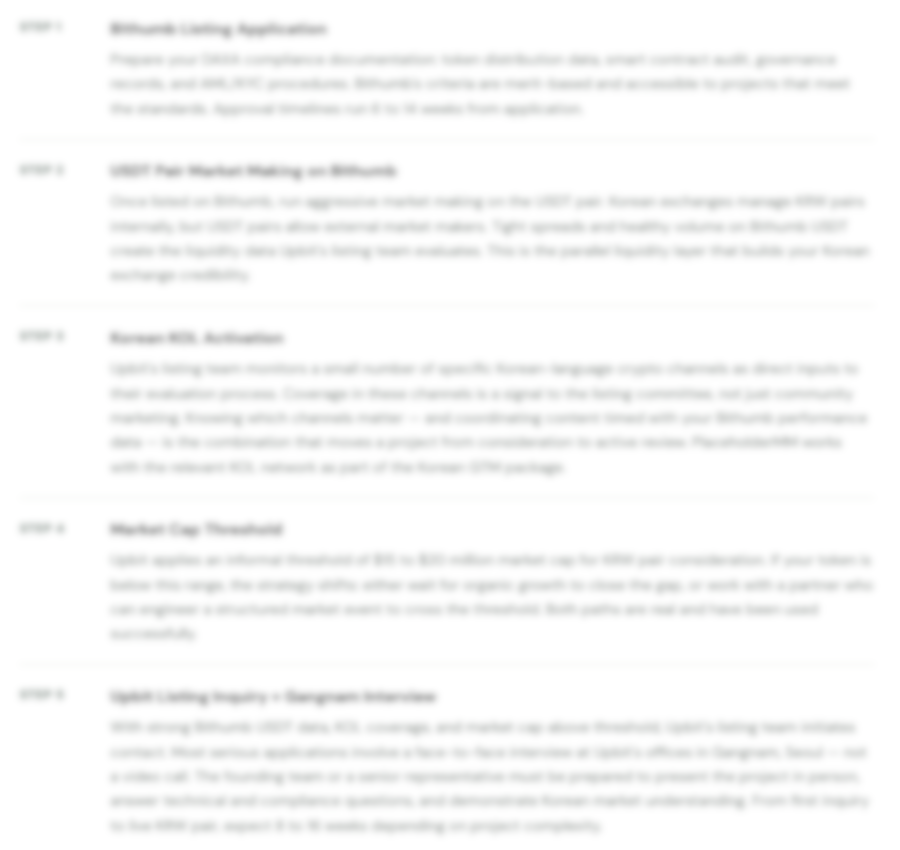
For most projects targeting Upbit, the realistic path runs through Bithumb first. This is not because Bithumb is a stepping stone in the reputation sense — it is because the liquidity data you build on Bithumb feeds directly into your Upbit listing application. Upbit's listing committee reviews your Korean exchange history. A project with three to four months of clean Bithumb USDT pair data is a materially more credible application than a project with zero Korean exchange presence.
The Bithumb pathway has a 50 to 70 percent conversion rate to Upbit when executed properly. "Properly" means USDT pair market making on Bithumb with consistent spreads, Korean KOL activation running in parallel, compliance documentation prepared to DAXA standards, and a market cap that clears the approximately $15M to $20M threshold that Upbit listing committees treat as a minimum for serious consideration. Projects that shortcut any of these steps see that conversion rate drop significantly.
Deal Structures You Will Actually See
The market making deal structures available for Korean exchange work fall into two categories: token loan with call options, and retainer plus token allocation. For a complete breakdown of how token loan agreements work — including what to negotiate and what red flags to avoid — see the founder's guide to token loan deals. Each has different risk profiles and different implications for your tokenomics. Understanding both before you sign anything is essential, because the numbers vary significantly between firms and the fine print on the call option ladder determines your long-term exposure.
Standard Korean Market Making Structure
Typical deal: 1 to 1.5 percent of total token supply borrowed interest-free for the engagement period. The market maker posts collateral to you and returns tokens at the end of the engagement or settles at pre-agreed call option strike prices. The upside for founders: you retain token ownership throughout, collateral provides downside protection, and the call option structure means the market maker's profit depends on your token appreciating. Specific strike levels and ladder terms are discussed during the engagement scope conversation.
Larger Firm Structure (GSR, Keyrock)
Monthly retainer of $8,000 to $12,500 plus a token allocation of 1 to 4 percent of supply. The token is typically locked with the market maker for the duration of the engagement. This model suits larger-cap projects where the token allocation is less sensitive. For mid-cap projects where supply management is critical, the ongoing retainer cost plus a meaningful token allocation can be harder to justify than the token loan structure.
The Competitive Map, Honestly
The question founders actually need answered is not "which market maker is best for Korea" in the abstract. It is "given my token's stage, market cap, and goals, who can actually help me get listed on Upbit or Bithumb, and what am I trading to make it happen." Here is the honest map.
PlaceholderMM
Korean-registered entity with locally compliant trading infrastructure, token loan + call option structure, no MM exclusivity requirement. Targets $5M–$300M market cap range. 50–70% Bithumb→Upbit conversion rate with full prep package.
DWF Labs
Number one Korean MM by deal flow and exchange relationships. 100% custodial, 3–5% supply, profit-share model, typically blocks other MMs. Genuine Upbit and Bithumb access. Use with careful legal review and full understanding of custody implications.
GSR Markets
Major institutional player with Korean project exposure through their investment arm. Primary model better suited to $200M+ tokens. Limited standalone Korean exchange execution compared to DWF or PlaceholderMM for mid-cap projects.
Wintermute / Flow Traders
Explicitly do not operate on Korean exchanges. Legal and compliance position. Excellent global CEX execution on Binance, Bybit, OKX. Not an option for Korean listing goals regardless of how the conversation is framed during a sales process.
Market Maker Comparison: Korean Exchange Coverage
| Market Maker | Korean Exchange Access | Deal Model | Token Stage | Key Risk |
|---|---|---|---|---|
| DWF Labs | Dominant (#1 in Korea) | Custodial + Profit Share (terms vary) | Any | Verify custody, exclusivity, and collateral terms before signing |
| PlaceholderMM | Korean Entity (Upbit + Bithumb) | Token Loan + Call Options | $5M–$300M | Lower Korean deal flow than DWF |
| GSR Markets | Limited (Investment Arm) | Retainer / Prop | $200M+ | Not suited to mid-cap Korean focus |
| Kairon Labs | Minimal (Bithumb only, indirect) | Retainer | $1M–$50M | No direct Upbit pathway |
| Wintermute | Will Not Operate in Korea | — | $100M+ | Legal / compliance position |
| Flow Traders | Will Not Operate in Korea | — | Institutional | Legal / compliance position |
Korean exchange access assessment based on documented public statements, market intelligence, and PlaceholderMM's direct knowledge as of Q1 2026. Verify current capabilities directly with each firm before engaging.
Three Questions to Ask Any Korean Market Maker Before Signing
The difference between a Korean listing engagement that works and one that costs you a significant chunk of supply without results usually comes down to three things you can verify before you sign anything.
- What is the custody structure? — Does the market maker hold your tokens, or do you hold them with collateral posted against the loan? The answer tells you everything about the incentive structure and your downside risk. 100% custodial arrangements require legal review that retainer-plus-token-loan deals do not.
- Does this engagement block other market makers? — Exclusivity in a Korean market making deal limits your global liquidity strategy for the duration. If you are running Wintermute on Binance and Bybit, confirm explicitly that the Korean engagement does not contractually restrict that relationship. Get the answer in the contract, not in the sales call.
- What is the Bithumb-to-Upbit conversion record? — If a firm is pitching Korean listing support, ask for documented examples of projects they moved from Bithumb to Upbit. Not case study slides. Ask for the token names, the timeline, and the market cap at time of Upbit listing. Any firm with genuine Korean track record will have this data readily available.
These three questions are part of a broader due diligence framework. For the complete list of warning signs across any market making engagement, see market making red flags to watch for when signing.
